Friday, 19 February 2016

Menopause in cetaceans

Another blog post written for Frontier, this time about the interesting phenomenon of menopause, or post-reproductive life, in cetaceans.

Let’s talk about sex, baby. Well, sort of, reproduction really but hopefully I caught your attention. Menopause. Probably something most people don’t want to think a lot about, but biologically it is actually really interesting… at least I think so.

Let’s think about it a bit, what is menopause? Well essentially it is just a female living on for many years after losing her ability to reproduce. It doesn’t sound like much, but from a biological perspective the entire purpose of any organism is to pass its genetic material on to the next generation, so once an individual loses its ability to do that, their existence becomes unnecessary. If a female can’t produce and raise offspring is survival really worth it? So it isn’t really surprising that very few species have long female survival periods after stopping reproduction, yet a few species do. Humans, of course, is the obvious one, but it also occurs in killer whales, possibly in elephants, and… you guessed it – short-finned pilot whales, the star of the Tenerife show!
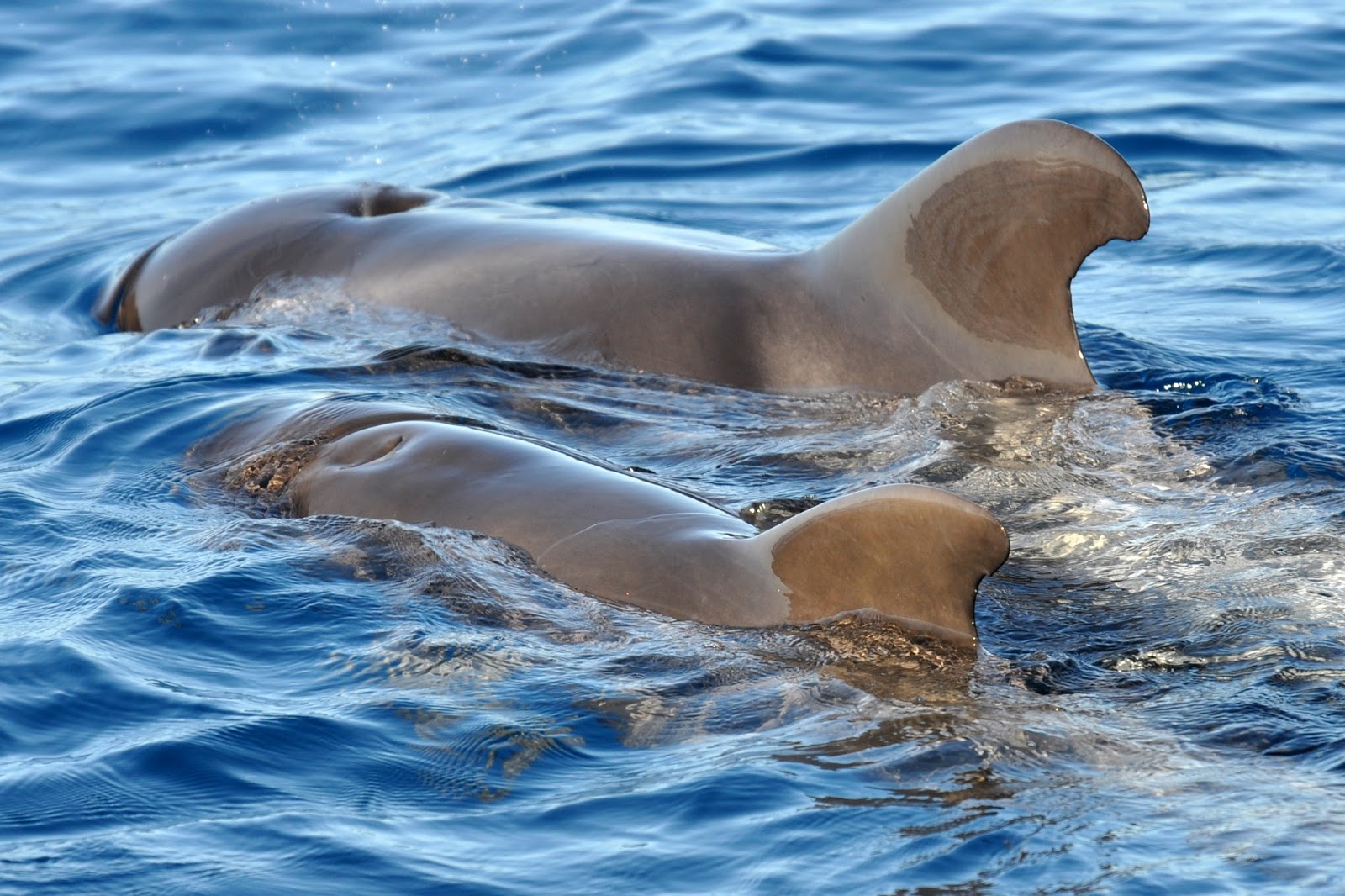
Adult and juvenile pilot whale


Since I’ve told you menopause is actually biologically unusual, you may wonder why it happens at all. It may help you to know that both killer whales and short-finned pilot whales exist in what are known as matrilines, or matriarchal societies. Here, female offspring will stay with their mother throughout their life, with in turn their female offspring remaining, forming a group of closely related females. Males tend to leave the group, at least partly, in order to reproduce with females they aren’t related to. Female short-finned pilot whales will not reproduce after the age of 40, yet they can live to around 65 years old, so there must be a good reason for sticking around for another quarter of a century!

Juvenile pilot whale surfaces to breathe


Granny, Grandma, Nanny, whatever you call her, everyone loves their Grandmother right? But think about how much knowledge she has, how many years of life experience she can pass on to her children and her children’s children. I’m sure if you think about it you’ve learned something from your Grandmother, even if it’s just the secret family recipe for the world’s best apple pie! Just as in humans, older female short-finned pilot whales hold a wealth of information which can help their offspring to survive and reproduce successfully. So even though she may no longer be producing more of her own offspring, her years of knowledge are ensuring that her genetic material that’s already out there is getting the best possible chance of surviving in to another generation. Let’s hear it for Granny pilot whale!

Friday, 22 January 2016

Photo-identification

A post I wrote originally for the Frontier Tenerife blog, aimed at showing potential volunteers what we get up to on the projects.

I’ve been spending some time working on an aspect of research which is used the world over, and is one of the most powerful tools available to those studying cetaceans – photo-identification.
As with almost any animal, no two individuals will ever look exactly the same, there will be some unique feature which marks them apart from others and can be used for recognising that individual. The idea with photo-identification is to take a clear photograph of that feature in order for it to be recognised again in the future. In some species this will be easier to identify and photograph than others, and the biggest problem with cetaceans is that they spend the majority of their time underwater and out of sight. The fact that they are mammals comes to our aid though, they must return to the surface at least occasionally to breathe, so we can use this opportunity to photograph them.

Different body features are used in identifying different species. In the giant blue whale, the pattern of spots along the side of the body is used, in right whales it is the unique clusters of white markings, or ‘callosities’ on their head, and in humpback whales it is the distinctive black and white patterning on the underside of the tail flukes. Here in Tenerife we are focusing on the resident species of short-finned pilot whales and bottlenose dolphins, both of which are recognised by their dorsal fins. Each dorsal fin is a slightly different shape, but this alone is not distinctive enough. Over the course of their life an animal will acquire nicks, notches, and scratches on the fin which make each one as unique as our fingerprints.


One set of photographs of ten different pilot whales will not give you much information – other than that you saw ten different individuals. But hundreds of sets of photographs of pilot whales, taken over years of research, becomes an incredibly powerful research tool. Not only can you say how many different individuals you have ever seen, but you can also say how many times each individual has been seen, if they have ever been seen with a calf indicating they are female, if they are always seen with the same other individuals suggesting a social structure, what times of day or year they are seen showing patterns in behaviour, where they are seen indicating important locations… the list goes on and on.

Friday, 8 January 2016

Tenerife

In late November I was offered the chance to work in Tenerife for six months on a cetacean project. I’m shocked that I have already been here six weeks out of my six months! They say time flies when you’re having fun, so I must be enjoying myself!

Form a personal career development perspective I’ve already learnt a lot, and gained fantastic experience, even in these few weeks on the project. Blessed with consistently good weather I’ve been lucky to get out on the whale watching boats regularly and to observe five different species of whales and dolphins, sometimes seeing three different species in one trip! I’ve seen bottlenose and common dolphins in other countries before but Atlantic spotted dolphin, Bryde’s whale, and short-finned pilot whale are all new species for me, and it is a great privilege to see these fascinating animals in the wild on such a regular basis. Of course the pilot whales are really the stars of the show here, and collecting behavioural observations during encounters with these animals is giving me a great chance to get to know more about another cetacean species.

Atlantic spotted dolphin
Bryde's whale


Short-finned pilot whale
Pilot whale close to the boat


I’m only just scratching the surface of what this beautiful island has to offer beyond the ocean. There is so much more to see and appreciate beyond the heavy tourism around the south. I enjoyed the novelty of Christmas day on the beach, but escaped the crowds on Boxing day to ‘enjoy’ a five hour hike up to the top of the cable car on Teide. The volcanic landscape there is beautiful, in its own rocky bleakness, and allows great views across the island, well worth the effort… but while it may be 22 C on the beach, up there it’s cold!

View from the cable car
Huevos del Teide

Before Christmas I had the chance to experience some of the stunning green mountains of Anaga in the very north of the island where you can’t escape the amazing views on a walk through the area. So I’ve packed a lot in so far and I’m really looking forward to exploring even more, and of course encountering more cetaceans, there are a few more species still on my ‘to see’ list...

Rogue Taborno
Beautiful Anaga region


Friday, 20 November 2015

Cornwall

After leaving the Isle of Man I was looking for another opportunity to live and work by the coast, so I took a job in the pretty little town of St Mawes, Cornwall. Whilst working in a small hotel, I used my spare time to explore the beautiful surroundings, as well as volunteer on some environmental projects.


St Anthony Head
St Mawes Castle


I began by meeting the coordinator of the Wildlife Trust Seaquest Southwest Project. Seaquest is a citizen science marine recording programme run by the Cornwall Wildlife Trust, and I got involved in a few public sea watches during my time in Cornwall. I was lucky enough to spot some marine mammals, including grey seals and common dolphins, as well as some of the weird looking sunfish! I also managed to get out on a great boat trip from Penzance a few times, for some closer encounters with the crazy looking sunfish.


Sunfish
Harbour porpoise near Penzance


I also volunteered with the National Trust at the Wildlife Watchpoint on the Lizard Peninsula. Situated in the most southerly building in mainland Britain the watchpoint is allows visitors to the peninsula to make use of the telescopes to spot the local wildlife. I was on hand to help point out the ever present grey seals, birds including the occasional Cornish chough, or any cetaceans which might be in the area. It was a beautiful place to spend some of my days off from work, and great to see the visitors' excitement when seal spotting.

Kestrel vs. Chough
Kestrel


After six great months exploring some of Cornwall, I had the opportunity to head to Tenerife for six months to work on a cetacean project, so that was my next move.

Monday, 4 May 2015

Recent rambles

Another jaunt up to Cumbria last month saw me staying at the beautifully located YHA Eskdale. The stunning location provided great views from the hostel garden, a lovely place to enjoy a walk around before dinner. I was hoping to catch sight of my first red squirrel, but no luck, so I settled for a fleeting glimpse of a jay against gorgeous clear blue skies. Just along the road, and up the slightly hair-raising Hardknott Pass lies Hardknott Roman Fort with low walls marking out the footprint of building once occupied by Roman soldiers and offering stunning views all around.

Lovely view
Hostel garden

Hardknott Roman Fort

A stop off for a quick walk around South Walney Nature Reserve provided a chance to enjoy the amusing sounds of the beautiful eider ducks, and to walk through a huge group of herring and great black-back gulls. I also came across loads of mermaids purses along the shore and picked up a few belonging, I think, to the smallspotted catshark.

Gull gauntlet
Piel Castle


With more promising weather I decided it had been too long since I had taken on a longer walk, so I set off for 12 miles around the Northamptonshire, Oxfordshire, and Buckinghamshire countryside. The day was beautiful, the walking good, and the wildlife did not disappoint. The raptors were around and I caught sight of three kestrels, one hovering very close over my head, three or four pairs of buzzards, and a red kite pair. A few of the fields also offered glimpses of hares hunkering amongst the low crops, and a stoat scampering along below a hedge but recognisable by its black tail tip. I lost count of how many skylarks I saw dart up in front of me whilst crossing fields, or how many I heard singing high overhead. It felt great to stretch my legs out a little further and enjoy the countryside.

Red kite pair
Spring lambs

A recent trip to Norfolk gave me just enough time to pop out to the coast at Horsey to get a look at the grey seals. It was a lovely blustery day, and walking a little further along the beach away from the crowds nearer the car park was well worth it for a private view of a larger group of seals. We kept a distance so as not to disturb the animals back into the water, but enjoyed watching them wriggling around on the sand for a while. Walking back along the beach there were lots of bird tracks with long lines running from the footprints. At first glance they made it look like something with a tail, but I think it was perhaps a crow not picking his feet up in the sand. We also came across two decomposed seals, probably juveniles judging by the size, and as a marine mammologist I just couldn't pass them by... I may have 'acquired' a seal skull which I'm working on cleaning up. The walk back to the car gave views of a few stonechats flitting along beside the path, and a small lizard scampering across in front of our feet.

Keeping a distance
Seals aplenty

Keeping look out
Wriggling around

Corvid tracks
Seal skeleton
Female stonechat

Tuesday, 28 April 2015

Some home patch exploring

Just a few minutes drive down the road from my house is a Wildlife Trust nature reserve and, shamefully, up until a few weeks ago, I had never been. It is only a small place, so I guess I'd always favoured the effort of going a little further to larger areas, but I'm glad I finally went. There was plenty to spot despite the small size, including a beautiful snake's head fritillary with some lovely purple flowers, and others such as cowslip beginning to bloom. Heading in to Spring, but still with few leaves on the trees it was easy to pick out lots of birds nests. There were many rooks around, and their high, messy nests, but also some much smaller and more delicate looking creations whose makers I was unsure of. There were lots of birds around though including goldfinch, robins, and great and blue tits. With a little dampness in the soil there was also plenty of evidence of animals which weren't actually seen, including Muntjac deer and badger footprints, as well as badger sett entrances which appeared to be active. A lovely short walk, well worth exploring the little places.

Snake's head fritillary
Cowslip


Frogs spawn
Rooks nests

Badger
Muntjac deer

A few days later I enjoyed the sunshine over the fields behind my house, with plenty to draw the eye. The blossom was bursting, the buzzards were flying, and the butterflies were dancing along the field margins. Though I have walked in these fields many times, to be able to escape out of my back door and so easily enjoy these little nature encounters will never get old.

Buzzard
Blackthorn blosson

Peacock butterfly
Two small tortoiseshells

Over the fields
Sunny spring day


I've fallen a little behind so there is another trip to Cumbria, a longer walk around home turf, and some seal spotting in Norfolk to come!

Thursday, 16 April 2015

Wildlife firsts!

A few weeks ago I had need to drive up to Cumbria, and so decided to break the long journey with a walk around RSPB Leighton Moss Reserve. Though the weather was a little grey and damp, I enjoyed a quick wander to stretch my legs and managed a few wildlife firsts along the way! Stopping off in one of the hides I was quickly treated to lovely views of a male and female marsh harrier sweeping over the reed beds. Though I've previously had a very distant glimpse of a male, this was a much better encounter, and great to see the two close together. There were plenty of wading birds around, as well as a pair of great crested grebes just beginning their courtship display. One of them was apparently not quite in the mood for love yet, and scooted off before they got to the stage of presenting plants to each other!

Colourful pheasant
Spot the snipe


Continuing along the path towards another hide I came across a male pheasant. Nothing too exciting you might think, but often they are skittish and don't allow you to get to close. I slowed my walking and eventually stopped and this guy was happy to strut right up to my feet so I could appreciate what colourful birds the males really are. I reached the last hide and sat a while watching a few birds and waiting while some other visitors clattered off down the path. Once it was quieter again I turned back myself, and was enjoying the peace when a sound caught my ear and I froze... did I imagine that. I thought I must have done and took a few more steps before I heard it, and stopped, again. I definitely heard that, and once more to be sure. My first audio encounter with a bittern! I heard the soft booming of a male, four or five groups of four calls, before quiet descended again and left me standing stock still on my own in the middle of the path with a stupid grin on my face!

Starting to court
Not ready yet


I wandered off again and topped off that incredible moment with a beautiful view of a goldcrest flitting along in the hedge beside me. Then I headed down to the coastal hides to enjoy watching some elegant avocets feeding in the shallow pools, not expecting to improve the much beyond the bittern. But soon I spotted my first kingfisher, who obligingly perched and posed on a post right in front of the hide! All in all highly enjoyable day, and somewhere I would definitely return to for a longer visit.

Teal
Obliging kingfisher


Not long after this trip it was time to head off to another European Cetacean Society Conference, this year in Malta. Yet again a great conference allowing the chance for a snapshot of all the great marine mammal research going on at the moment, particularly in Europe but other places too. Alongside this is the fun of socialising with others working in the field and get a glimpse of a new country... and enjoy a little spring sunshine too.

Capital Valletta from Sliema

Spinola Bay by night
Mix of old and new in Spinola Bay

Evening waves in Valletta
Siege Bell memorial and Valletta Grand Harbour


Look out for more reports from the local home patch coming soon.